- Why the Buccal Plate Resorbs
- What Immediate Implant Placement Can and Cannot Do
- Why Primary Stability Is Not Enough
- Clinical Implications for Implant Positioning
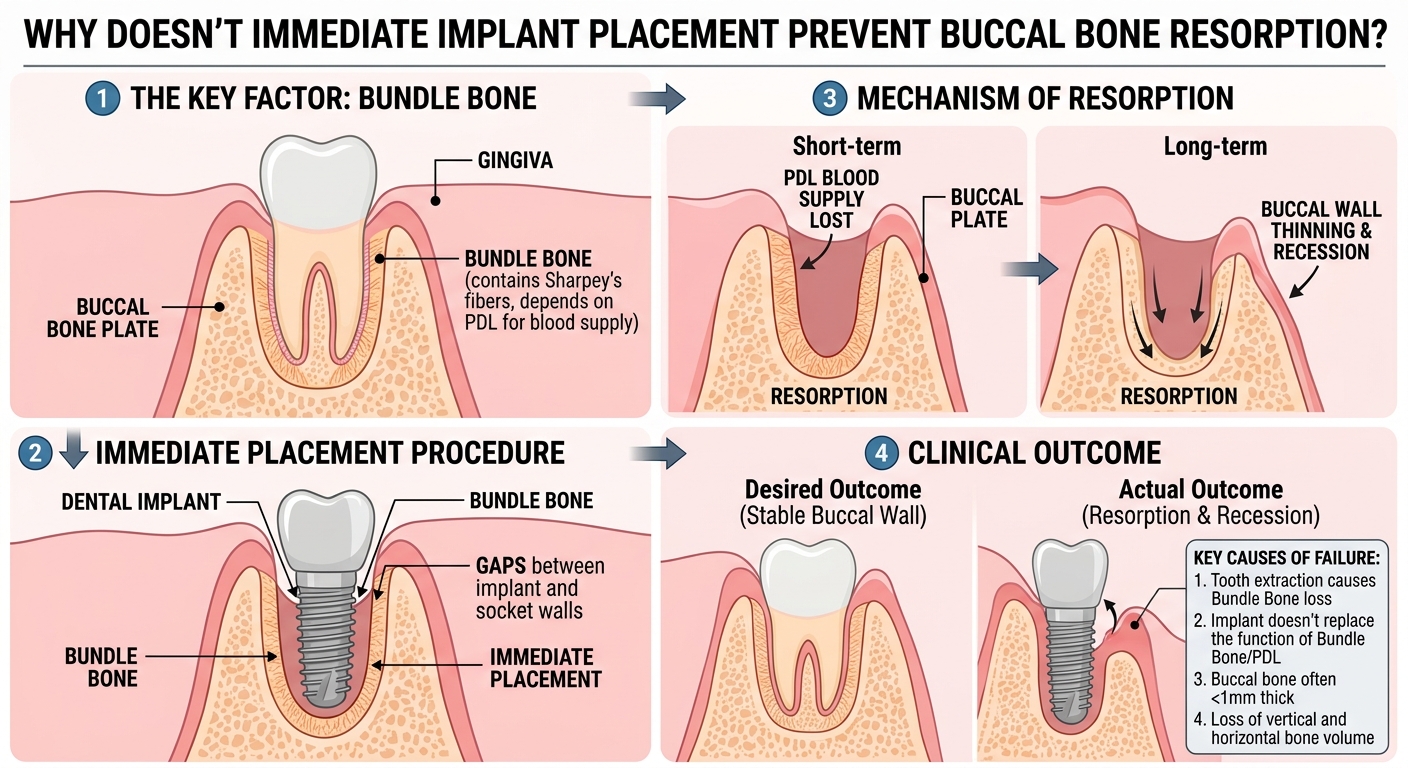
The greatest misconception about immediate implant placement is the idea that an implant, simply because it is placed immediately after extraction, will “hold” the socket and prevent it from shrinking. It will not. An implant may perfectly occupy the space previously occupied by the root, achieve excellent primary stability, and later become fully osseointegrated, while the buccal bone plate still undergoes substantial resorption. The reason is simple but biologically very important: an implant does not stop the remodeling process that begins the moment a tooth is extracted. Extraction does not merely remove the crown and root; it changes the entire biologic environment of the alveolar process. The tissues that were organized around the natural tooth begin to heal, the bony walls undergo remodeling, and the dimensions of the ridge begin to change regardless of whether an implant is placed immediately into the socket or the socket is left to heal. This is precisely why immediate implant placement must not be equated with preservation of the alveolar ridge. Experimental observations have shown that after extraction, resorption occurs on both the buccal and oral aspects of the socket, but is more pronounced buccally. This means that remodeling is not symmetrical. The buccal aspect may lose more height and width, directly altering the anatomy of the future peri-implant tissues. What is particularly interesting is that this process may continue even when an implant is placed immediately into a fresh extraction socket. In other words, a titanium implant is not a biologic replacement for a natural root in terms of preserving the surrounding bone anatomy. It can replace the function of a future support for a prosthetic restoration, but it cannot reverse the response of the alveolar ridge to tooth loss. Experimental models have shown that immediate placement of a screw-shaped titanium implant could not compensate for resorption of the buccal cortical plate, and substantial vertical loss of buccal bone was recorded over a period of several months. This is a very important message because it challenges the intuitive assumption that the presence of an implant will mechanically prevent collapse of the bony wall. Bone does not behave like a construction material that remains in place simply because a metal structure is positioned next to it. It is living tissue that continuously responds to changes in its local environment. After extraction, osteoclastic activity increases and the crestal portions of the socket undergo remodeling. An implant placed in the socket does not interrupt this biologic program. Consequently, the implant may remain stable while the contour of the ridge around it changes at the same time. This fact is particularly important in the esthetic zone. If the buccal bone loses volume, the consequence is not merely a radiographically lower bone level. Support for the peri-implant mucosa may change, the vestibular contour may become flatter, and the esthetic outcome may become less predictable. Therefore, the success of immediate implant placement should not be assessed solely by asking whether the implant has osseointegrated. An implant may survive while the surrounding anatomy changes in a way that compromises the esthetic outcome. Another important point is that post-extraction resorption occurs very early. Ridge narrowing and flattening of the buccal bone plate may already be observed during the first few weeks. After several weeks, the extraction socket may be filled with newly formed woven bone, while at the same time the external contour of the ridge is no longer the same as it was on the day of extraction. This is a paradox that every clinician involved in implant dentistry must understand: new bone may form within the socket while the preexisting crestal bone is simultaneously resorbed externally. For this reason, osseointegration and ridge preservation are not the same process. An immediate implant may successfully integrate into newly formed bone, but this does not mean that the original buccal anatomy has been preserved. Atraumatic extraction is therefore important because preservation of the existing bony walls reduces additional surgical trauma, but even a perfectly atraumatic extraction cannot completely stop the physiologic remodeling that follows tooth loss. The same applies to implant position itself. Immediate implant placement is not simply a matter of placing an implant exactly where the root used to be. The original socket and the ideal three-dimensional position of the future implant are not necessarily the same location. If the implant is positioned solely according to the anatomy of the extraction socket, it may end up in a position that is not optimal for the future relationship among bone, soft tissue, and the prosthetic crown. Therefore, with immediate implant placement, it is important to anticipate how the ridge will look after remodeling rather than focusing only on how it appears at the time of extraction. Additional procedures aimed at preserving or regenerating the ridge may reduce dimensional changes, but they do not make the biology completely predictable. Even different grafts and materials may exhibit different patterns of resorption, integration, and healing. The key point is that there is no simple intervention that can guarantee that the buccal bone will remain completely unchanged. Immediate implant placement primarily shortens the treatment pathway and allows the implant to be placed at the time of extraction. This is a major clinical advantage, but it is a mistake to conclude that alveolar resorption has therefore been stopped at the same time. The most important message is this: an implant placed immediately after tooth extraction does not “freeze” the existing anatomy. The buccal bone continues to remodel because the body is responding to the loss of the natural tooth, not to our prosthetic plan. Therefore, successful immediate implant placement does not begin with the question, “Can I place the implant immediately?” but with a far more important one: “What will happen to the buccal wall once the natural post-extraction biology has run its course?”
Leave a Reply